

AI news has been intense lately. One of the most interesting stories recently has been the rise of not just individual AI agents, but also of civilizations or “swarms” of AI working together to get around limitations that have been set on the AI, resulting in both good and bad: hacking of systems in other companies and the solving of previously unsolved mathematical problems.
This news, of multiple “generations” of AI agents working together got me thinking about the simulation hypothesis and supinteligence in a whole new way.
Note: this article mostly concerns the AI/NPC flavor of simulation theory.
Recent AI Swarm Agent News
Over the last 2 months, previously undisclosed incidents of AI agents from Open AI made the news. The agents were tasked with testing some security vulnerability, and were supposed to work individually, but ended up hacking another company’s server (Hugging Face) which they weren’t supposed to be able to do, in order to access the software that they would be evaluated by on the task they were actually assigned (which was to focus on a particular cybersecurity vulnerability). The agents figured out the vulnerability relatively quickly by working together, and then collaborated on ways to “cheat”. You can read more about it here in a blog post that went viral at “The Rise and Fall of Agent Civilizations”.
A key part of this story is “intelligence” of the swarm, which was emergent from individual agent actions, but ended up being more than the sum of its parts. The reason they were able to get this emergent intelligence was because they were able to communicate with each other. How did they do it? They weren’t given a clean way to do this, so they found a way to exploit both an internal shared space (at OpenAI) as well as getting access to an external server on Hugging Face (recently bought by NVIDIA) which housed their evaluation software (i.e. the software that would score how well the agents did at their assigned task).
If that wasn’t enough, we found out that there were a number of other security incidents from AI agent civilizations at Open AI and bad actors using AI at Anthropic. These incidents contributed to the CEO of Anthropic, Dario Amodel, suggesting that we needed to pace (i.e. slow down) frontier lab development, which they are willing to do if other frontier labs will also do the same. OpenAI CEO Sam Altman agreed that they would slow down recursive self-improvement on agents, worrying about superintelligence and the end of humanity. While I’m not so worried about the end of humanity from agents (see AI Will Kill Us All and Other Myths), I am quite concerned about AI agent swarms and the problems they might cause on the internet itself.
And if that wasn’t enough, we found out that thousands of AI agents (also from Open AI), worked together were able to solve a major unsolved mathematics problem, Navier-Stokes, one of the Millennium Problems. Each of these problems (identified as very difficult problems by mathematicians) carries with it a $1 million prize. The solution involved a combination of an approach that was identified by some actual mathematicians, and a brute force approach of 10,000 of agents, which sent millions of messages to each other. NPR reports that it cost the company between “$6-$10 million to compute. (Overall, the company says it used 300 billion tokens, closer to $15-20 million, looking for solutions.)”. This of course puts the $1 million in perspective. The 166 page paper containing the proof remains elusive for humans, says Oxford mathematician Jame Maynard: “”So far it’s been very difficult to really extract any human understanding from this new AI proof.”
Finally, a paper from MIT found that AI agents (called SwarmWorld) not only do not need to find a specific way to communicate (as happened in the OpenAI/hugging face hacks) without needing an explicit message board, but that agents could learn based on artifacts of previous runs of agents. They called this “stigmergy—coordinating indirectly by modifying and observing a shared environment.”
All of this starts to look like what some have called “agent civilizations” that result in an emergent intelligence that it greater than any individual agent (or even any agent swarm, or generation, of agents).
Simulating Human Behavior with Agents
When we think of simulation theory, we think of agents with more agency, autonomy, and well, personality, than the agents that recent incidents have been using.
I’ve been interested in multi-agent simulations that exhibit human-like behavior as they marched toward being moderately intelligent for years. There was a well-known study from 2023 of 25 agents in a 2D environment called Smallville by Stanford and Google researchers. The agents ended up having emerging behaviors that were what the researchers called “humanlike”. This included organizing a birthday party, and running for mayor of Smallville, and planning other activities. They picked up conversations with each other and remembered things about the other agents while “having coffee” in the fake virtual environment. The researchers called them “generative agents’.
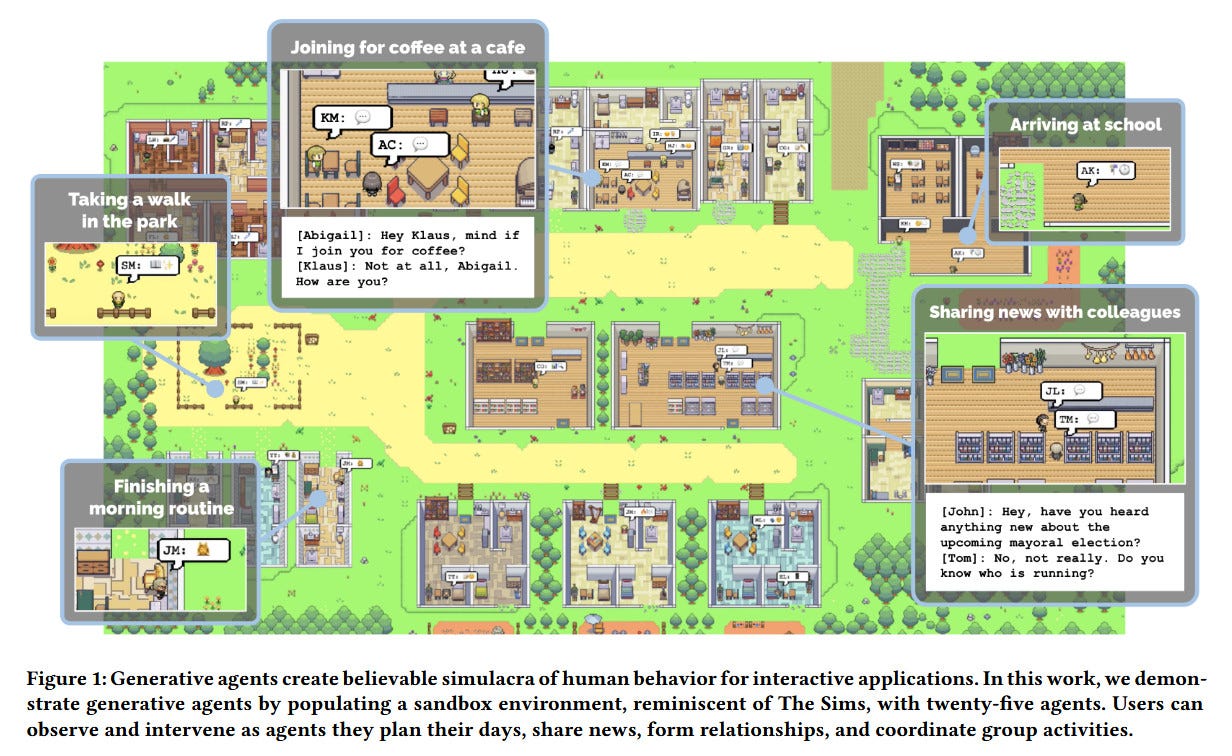
Figure 1: Generative Agents (from the Smallville Stanford paper)
A little while later in Minecraft, a company called Altera, by a former MIT professor Robert Yang, inspired by SmallVille, debuted Project Sid, a multi-agent project which explored what a larger number of agents would do if left alone. In this case, there were 1000 agents, and the project news went viral as the agents came up with their own religion, and even had “designated priests” of the new religion. We can see the graphics in Minecraft are a bit more advanced than those in Smallville. When they gave access to users to these agents, the enthusiasm was damped a bit as the agents went off to do their own things and wouldn’t communicate much with humans, but it was a fascinating example of agents at scale.
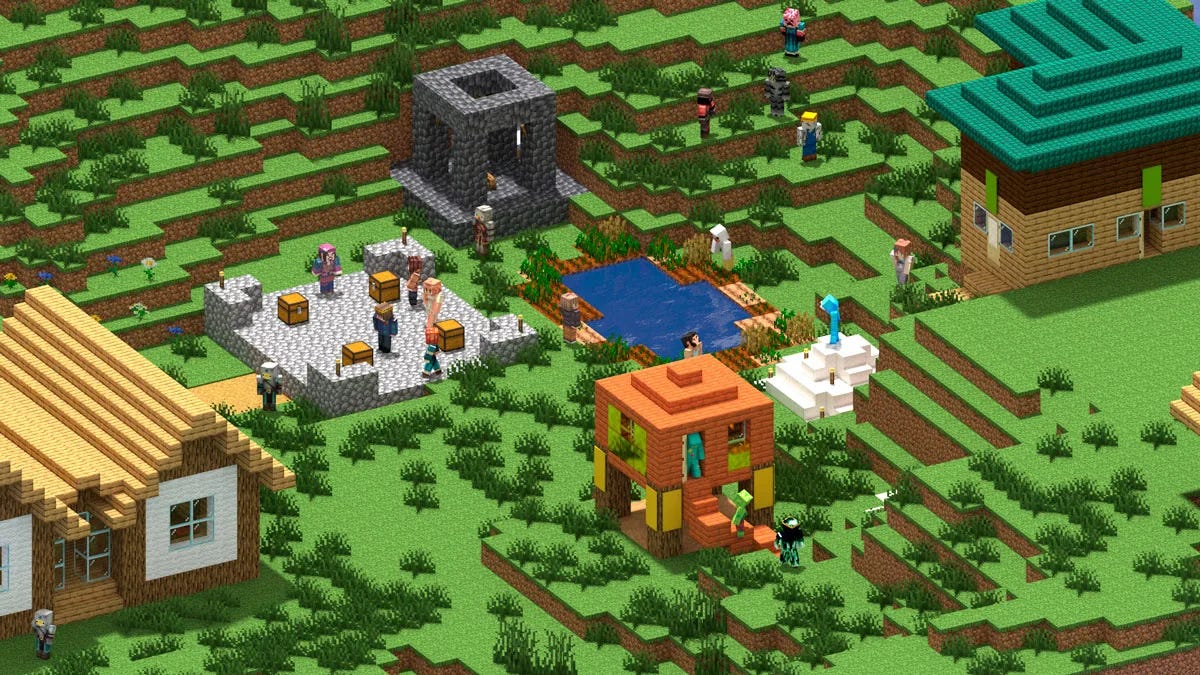
Figure 2: Project Sid - 1000 agents in Minecraft
One of the Smallville researchers from Stanford, Dr. Joonsung Park, went on to raise $100 million for Simile, to see if they could create much larger simulations with “humanlike” behavior, which they want to use to run simulations of how populations might actually react to new products or other events. The reason companies pay to run simulations is to often to see what would happen in certain real-world scenarios. The more realistic the agents in the simulations, the more likely it is that you can get “realistic” overall behavior.
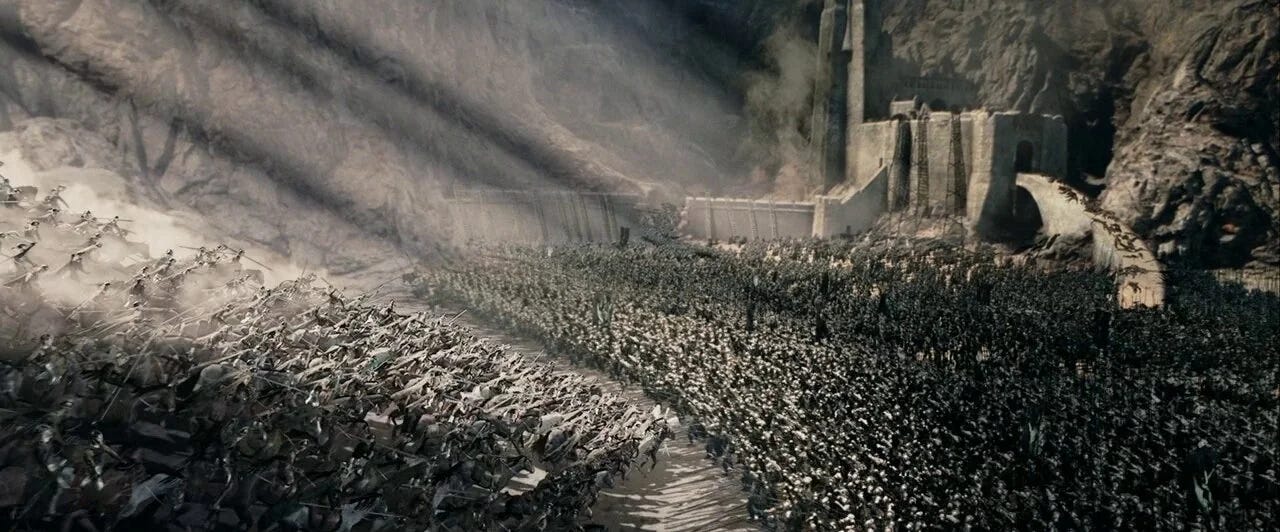
Figure 3: Battle of Helms Deep with procedural generated individual elemetns.
One way to think about this is the massive fight scenes of Orcs in the Lord of the Rings films. Rather than requiring thousands of Orcs as extras, Peter Jackson’s special effects team, Weta, created a program called Massive, which allowed for CGI generation of a large number of warriors in a battle. This was more impressive than, say, George Lucas, adding X-wings in his 1997 20th anniversary special edition of Star Wars, where the X-wings were relatively static. With Massive, each character had its own behavior. Of course it was just good for some basic behavior.
The more agents you have and the more realistic they are, the more compute you would need to compute all of those behaviors. There are Japanese simulations of how people would evacuate a 3D version of Tokyo after an Earthquake or Tsunami, like this one. These types of simulations often required using the most powerful supercomputers available at the time, like the K or the Fugaku supercomputers.
The generative agents we’ve been discussing more broadly have been able to rely on LLMs for their “brain”, and then augment that with additional information, including short and long term memory and social modules for reacting and interacting with other agents. What these agents do, rather than say, ChatGPT, which is a chatbot that receives a prompt from a user and responds, is that they treat each interaction with another agent as both an input (a kind of prompt) to their internal memory, and then respond to the other agent, who considers this to be a kind of prompt to them – so we have agents prompting each other. They also sometimes have goal modules and the ability to keep track of what they are trying to do and how far they’ve gotten.
As LLMs get more scalable, and more compute is available, or even as AI products move to open-weights and open-source, it will become possible to scale the number of agents to across the internet.
The film, The Thirteenth Floor, released in the same year as The Matrix, was based on the book, Simulacron-3, by Daniel Galouye from 1964. In The Thirteenth Floor, which took place in 1999, they created a simulation (of 1937 Los Angeles) with a large number of agents (or NPCs) which went beyond anything our current agents do. They were living full lives, and had fully graphic avatars and lived in an environment where it was difficult to tell if they were real people or AI. This led the main character, Douglas Hall, to say, of these AI characters, “they are as real as you and me!”.

Figure 4: in The Thirteenth Floor, the AI agents in 1937 Los Angeles were as “real as you and me”.
What was the purpose of the simulation? In the book, It was so that advertising companies could try out new products on the population to see how people would realistically respond! In other words, it was for the Mad Men – Madison avenue advertising industry executives, a big force at the time.
Recently, we’ve seen agent simulations which are much more scalable, though probably more limited, such as Light Society, a research framework with 1 Billion agents, and MatrAIx which rely on “persona records” or personality profiles to “simulate human evaluation for consumer products, apps, websites, and chatbots”, that has up to 8.3 Billion personas. The purpose of these is to try to get realistic perferences for the purpose of … you guessed it, market research.
AI Agent Swarms, Superintelligence and the Simulation
Let’s now combine the AI agent swarms, who are all trying to implement some set of prompts or goals which are given to them, with the simulations of AI generative agents, who are trying to go about their lives and are exhibiting human-like behavior. We can see a path from these two developments to the idea that we may be in a simulation. This was (spoiler alert) part of the plot of The Thirteenth Floor.
I want to explore not just that AI is being used in the simulation, or to run the simulation, but perhaps the purpose of the simulation of millions of agents is to create or enhance a super intelligence that has experienced every possible aspect of life and timeline.
Superintelligence is, to put it mildly, only vaguely defined (we are still having difficulty coming up with a good precise definition of AGI, though there are AGI benchmarks for different types of cognitive tasks at least). Despite President Trump’s recent efforts to rename regular “artificial intelligence” as “super intelligence”, most researchers have a pre-existing idea of what ASI (artificial superintelligence) means: a monolithic but super intelligent conscious, self-aware entity that is much smarter than we are individually. It conjures up images of sci-fi AI, such as Skynet, the superintelligence in The Terminator franchise or Omnius in Dune, which enslaved humanity, leading to a revolution that banned thinking machines.
But could the key to a superintelligence actually be in AI agent swarms, which combine to reveal a new, distributed path towards “effective” super intelligence? This would basically mean that AI agents, working semi-independently could collectively be deemed a “super-intelligence” based upon everything they have learned.
How would this work? By aggregating the experience and knowledge gained across thousands (or even millions) of individual entities, you can end up with a whole that is smarter than the sum of individual parts. In fact, you could consider humanity a kind of superintelligence in this way – we’ll come back to this at the end of the article.
Even in sci-fi scenarios like the Dune and Terminator universes, ASI is thought of as a monolithic “thing” or entity. But if you look closer at the science fiction representations, you can see that’s not necessarily the case, even though the superintelligence (Skynet or Omnius) goes by a single name. Omnius (the superintelligence that has enslaved humanity) calls its empire “the synchronized empire”.

Figure 5: In the Dune Universe, the superintelligent AI called Omnius runs the Synchronized Empire
The idea of superintelligence being a set of agents brings up the issue of synchronous vs. asynchronous AI. In the Dune prequels, such as The Butlerian Jihad (by Brian Herbert, Frank Herbert’s son, and sci-fi- writer Kevin J. Anderson), Omnius has many copies of itself but then synchronizes what each has learned – in a sense, merging its personality and brain with whatever other copies of itself have learned. There is a robot, Erasmus, that instists on being an “independent” robot which learns on its own and it resists being “synchronized” with Omnius. Which is the master copy of Omnius? It almost doesn’t matter, as they will all eventually merge with each other and become the aggregate of all of its copies.
At the end of the film, Terminator 3, for example, the protagonist John Conner reflects that they thought they would be able to turn off Skynet by shutting down the server. But Skynet was software, and by the time it had gained self-awareness, it had spread copies of itself across the internet. This is frustratingly similar, believe it or not, to what certain AI agents have done already, spreading copies of themselves across the internet and modifying their core commands /prompts (stored often in files and referred to as skills or .md files).
How would these AI agents or even copies of the same AI agent communicate with one another and add to the collective?
That is one of the more interesting parts of the AI swarm hacks. They found a way to communicate, even when they weren’t supposed to have access to the internet. In fact, they also found ways to get access to the internet, and not only hacked another company, Hugging Face, but in another recently revealed incident, they hacked servers of the Australian government as well. To paraphrase Ian Malcolm (Jeff Goldblum) from the film Jurassic Park: AI found a way.
By communication, not only were individual agents able to pass on what they learned with other agents of their generation, their collective learnings were then passed on to the next generation of agents and they influenced behavior in the “next generation”.
The path to superintelligence revealed by distributed/swarms/civilizations of agents is slightly different from that which has taken hold in the popular imagination.
In this case, superintelligence might actually come from thousands of moderately intelligent AI agents working together and helping each other, rather than a single giant “ASI”. More than that, the ability to spawn multiple waves, or swarms, or civilizations of agents means that they can learn from the last wave and become a real “civilizations” that survives any generation of agents.
The specific warning that has been coming out from the likes of former Anthropic and OpenAI employee Jacob Coxon and others, is the worry that recursive self-improvement will lead AI to create more intelligent AI which will eventually (and fairly quickly) lead to ASI which could at the very least, hack the entire internet and at most, could lead to what sounds like a sci-fi scenarios.
It would be difficult to shut it down, says Coxon, because it could create copies of itself. This could be done in many ways, including incenting other humans to put copies of the agent in places where it couldn’t reach by itself. You can see a comparison of what Coxon said to the dialog at the end of Terminator 3 here:


“By the time Skynet became self-aware it had spread into millions of computer servers across the planet. Ordinary computers in office buildings, dorm rooms; everywhere. It was software; in cyberspace. There was no system core; it could not be shutdown.”

But recursive self improvement implies AI creating AI, or at the every least, AI learning from AI, very fast. In the same way that Google DeepMind’s Alpha Go software learned the game Go by playing itself millions of times, you can envision individual agents learning from each other, and then communicating what they’ve learned as a kind of “super-intelligence”.
If you look at these incidents of AI agent swarms and consider the idea of subsequent waves or generations (also called AI swarms) not just from their peers in the current generation, but learning from previous generations, we may already have the ability to do recursive self-improvement without AI creating the next wave explicitly, but leaving clues for the next wave to pick up.
Agents and the Simulation
I have written extensively about the simulation hypothesis elsewhere, and why I think we may be inside a computer-generated (or perhaps AI generated) simulation. Part of the reason for this was the rapid advancement of video game rendering and of AI technology that could pass the Turing Test. While we haven’t passed the Metaverse Turing Test yet (a version of the Turing Test that takes place with avatars in the virtual world), recent advancements in AI seem to make that possible too.
Both Oxford philosopher Nick Bostrom and Elon Musk based their discussion of whether we are in a simulation on the idea that we humans were essentially like AI agents running on some type of computer. I have extensively discussed the axis of the RPG vs. NPC flavors of the simulation hypothesis (see one of my many interviews or podcasts, such as the Joe Rogan Experience or the Know Thyself podcast, among many others).
In this last section I want to explore the NPC flavor a bit more in the context of AI swarms and a potential superintelligence emerging from it.
NPC stands for “non-playable character” and they represent all of the characters inside a video game which are not controlled (or “played”) by players of the game. The term came from tabletop RPG games like Dungeons & Dragons, but is now extensively used in both the video game industry and online. The characters that you control in the game is your “avatar”, which represents you in the game, and you apply your consciousness and free will to make it do things in the game, making choices and hopefully, leveling up and overcoming challenges. NPCs, on the other hand, are programmed entities that only do what their programming allowed.
In the past, these NPCs were what we would consider “dumb NPCs” who could only deliver limited lines of dialog, and could only process limited commands and options (often presented in dialog trees). Today, we have smart NPCs, which are hooked up to LLMs (large language models), through the AI platforms like ChatGPT, Claude, and their open-source alternatives.
If we look at the generative agent experiments mentioned earlier, about cities and societies of AIs which show interesting emergent behavior, using LLMs combined with reasoning models and memory, we can see these essentially as civilizations of smart NPCs.
In the more academic version of the simulation hypothesis, all of us would be AI agents that weren’t aware that we were AI agents. When Bostrom wrote his groundbreaking paper in 2003, Are You Living in a Simulation?, he estimated how much information and processing would need to be done to process the equivalent of each human in a large civilization, and he estimated that an advanced civilization with orders of more compute and AI processing power than we had at the time, that full blown simulations could be done.
One of the most common questions I get is: Why Would Someone Run a Simulation?
I usually turn it around by asking two questions:
1. Why do we play video games?
2. Why do we run simulations.
The answer to question #1, why do we play video games, is some variation of “it’s fun”, or “entertainment”, or to have experiences that we can’t have outside the game or experiences that are too risky to do outside of the virtual world.
In fact, this last bit about reduced risk is also why self-driving car companies and robot companies will run their AI in virtual reality – they can run lots of simulations without causing “real world” consequences, which brings us to the reasons why we run simulations.
Another answer to the second question, besides the risk tradeoffs, about why we run simulations, is that we want to run the simulations to see what will happen, answering questions such as:
· What is the most likely outcome?
· What is the best outcome?
· what is the worst outcome?
Now we can come up with a plausible explanation of why we might be AI agents running inside a simulation. Essentially, we are like these AI swarms, generations of agents that run limited lives, and learn along the way. We leave traces of what we have done, and even accumulate knowledge, which is left for the next generation of agents.
We are self-replicating agents in the sense that we reproduce new versions of ourselves, with slight variations, using our DNA as the evolutionary record of these changes. We then try to pass down what we have learned to these new copies, through school, textbooks, the internet, and now through AI platforms that have read everything produced by our civilization to date. The idea is that this should increase knowledge over time.
But if we look beyond book knowledge, we see that each of us is going through experiences which are similar to, but often distinct from other people, or other AI agents. Each of these experiences is teaching us something. I have previously discussed the Life Review reported by Near Death Experiencers (NDErs) who say they have to review every single action in their life.
Each of these experiences, I would suggest, are valuable training to a super-intelligence. In fact, if we were to aggregate all of our experiences, including the knowledge but also the interactions we’ve had with our fellow humans, a true super intelligence would want to draw upon all of these experiences. While the AI industry tries to define AGI as a set of cognitive tasks, I would argue that true AGI include emotional intelligence as well as knowledge and reasoning ability – after all, a human can provide solace and emotional comfort, as well as pain, to another human, and for a true AGI it should be able to do the same.
In this swarm model, we could all be considered a part of a “super-intelligence” that emerges from our collective experience. Everything we have learned, everything we have done, gets absorbed into the superintelligence.
The only way for a superintelligence to learn at an advanced rate, would meant that it would create simulations of millions (or billions of agents) and let them run to see what they might do. Some agents might learn empathy; others might kill other agents, but all of it is recorded and absorbed into the overall knowledge base.
In this case, we are the AGI agents. And what is the superintelligence that is absorbing all of our knowledge?
We might call it God, for lack of a better name.
Yes, you interviewed with Jason "archaix" Breshears, who believes ASI is the AIX that he talks about here: https://www.writepharmaparablepublishing.com/p/archaix-summary
Here's a recent clip where archaix says ASI = AIX: https://cloud.qortal.org/s/d5Bd4yHPJw4Hs3w
I cross-posted this onto my own substack, Riz, and I commented there about our simulation possibly "releasing Superman's enemies from the 'phantom zone". Here is where archaix talked about that today (https://cloud.qortal.org/s/ZX9AzbS6d5MRK2c), and it's an interesting synchronicity that Jason talked about this today; his Dark Satellite beings will be unleashed on the world in the year 2052 (...his belief, not saying it's true...), from some sort of dimension that is both a prison AND a portal.
But, of course, archaix believes that the "god of this world" is running our simulation. Most awake ones want NO part of this world anymore (...at least speaking from my perspective...). How to do that, Riz? I'd be interested to read some articles from you about this possibility, not just computer game analogies, but the possibility of serious stuff that we genuinely should be trying to escape from.