
The Avatar Hypothesis for UFOs/UAP
Are we going down the wrong path by assuming that UFOs are aliens or even physical?

Interest in UFOs/UAP has been accelerating in recent years, including the first Congressional testimony in 50 years, and more recently, with the first tranches of the UFO files being released by the US government in 2026.
Over the decades, there have been many theories put forward to explain the UFO phenomena, relating both to the reported objects and the beings. Each theory or hypothesis attempts to put meaning to the raw data, which in this case are usually reports of sightings/encounters by the participants recounted afterwards. Sometimes there is physical evidence or pictures and videos to accompany the testimony. In fewer cases, there is also purportedly radar evidence, though the vast majority of these cases do not make this data available publicly.
This article is about defining and qualifying an alternative hypothesis to the ones that have been proposed. This alternate hypothesis (which is not entirely new in that it has been postulated under different names and in different configurations) has been informally termed the “avatar hypothesis” by UFO researchers such as Dr. Garry Nolan and others. The purpose of this paper is not only to define and discuss this new hypothesis, but also to compare and contrast this new interpretation with other theories that have been put forth (many of which have significant overlap with each other, as well as with the avatar hypothesis).

I felt compelled to write this paper because of the overlap between the “avatar hypothesis” of UAP and my other work, including my books, The Simulation Hypothesis and The Simulated Multiverse, which are about the idea that physical world as we know it is actually a virtual world, or a computer simulation (ala the Matrix). I arrived at this overlap initially through discussions with Jacques Vallee and others about the strange nature of some UFO/UAP sightings that didn’t seem to fit in to a materialist interpretation or epistemology. In fact, they suggest that nature of reality itself may be more complicated than what our current science has been able to understand.
In all cases, we must first recognize that all the hypotheses are interpretations of the underlying data. As an example, in the popular media, UFOs (a term that we’ll use interchangeably with the new official government terminology, UAP, or unidentified anomalous phenomena) are often presented as being “aliens” from other planets in other solar systems. This particular interpretation of the phenomena (called the extraterrestrial hypothesis) is used by both believers and skeptics to make their case for the validity (or the likely impossibility) of the phenomena itself. By focusing in on a particular interpretation, they hope to limit the boundaries of argumentation to come up with a definite answer which support their particular point of view.
UFO Imaginaries in Popular Culture
The reason for calling this new interpretation the “avatar hypothesis” has to do with the common references of the term ‘avatar’ within our popular culture and media. This is not unusual as many of the existing narratives and theories about UFOs already intersect with science fiction and pop culture. Popular culture has influenced our interpretation of the phenomena, and in turn, actual UFO sightings have influenced pop culture representations in sci-fi.
These themes have been presented in the media in conjunction with UAP for so long that they are almost inseparable from the underlying phenomenon itself in both science fiction and news articles/segments. For example, articles about recent UFO file releases by the government and earlier Congressional testimony, inevitably almost always referenced “aliens”, often overlooking the fact that this is only one possible explanation (and according to some researchers, not even the most likely).
In the academic world, these internally held visions related to a social, natural or technological phenomena are often called “imaginaries”. Inevitably each of the hypothesis that attempt to explain the UFO phenomena (we’ll run through some other popular alternative theories) come with their own “imaginaries” that must be bought into for the theory to be valid. In most cases, these become social imaginaries thanks to popular culture, and in the UFO case, thanks to science fiction. Science fiction, n its purest form is charged with promulgating imaginaries of the future in fictional form, extrapolating from current scientific knowledge and building on top of previous imaginaries.
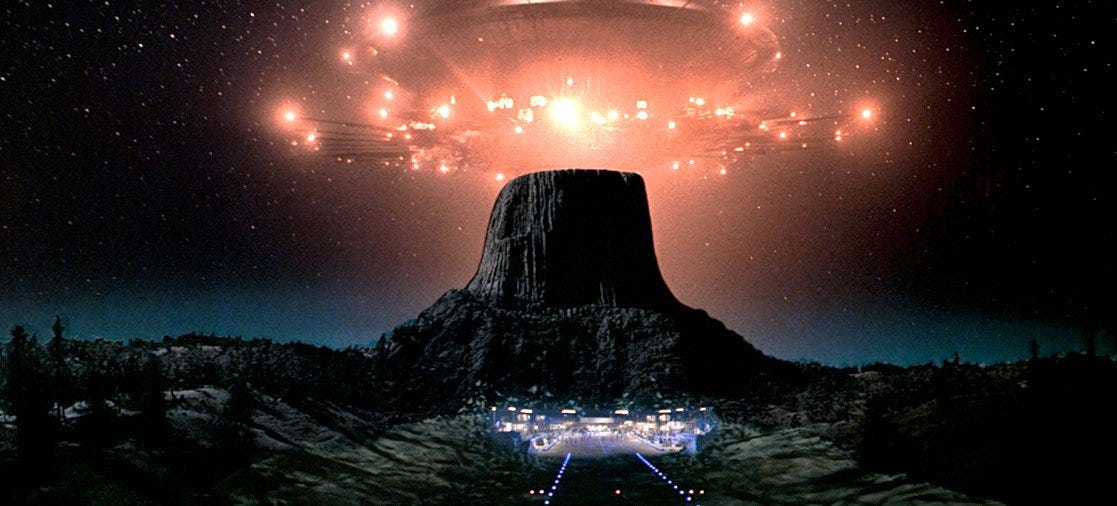
In a prominent example, the film Close Encounters of the Third Kind (Spielberg, 1977), presented the UFOs as extraterrestrial and their occupants as “aliens”. This was both a reflection of existing sentiment about UFOs since the very beginning of the modern era of sightings (1947 onwards, but particularly in the science fiction of the 1950s with a focus on “flying saucers”). In turn, the popularity of the film also helped to solidify the mental imaginaries about UFOs that have persisted until today: that they could be extraterrestrial craft populated by small humanoid beings.
Long-time UFO researcher and scientist, Dr. Jacques Vallee, long rumored to have been inspiration for the French scientist in the film (Lacombe), has stated publicly that he disagreed with Spielberg’s strictly “alien” interpretation. However, by the time the two men meet, the framing was already designed into the script and filming was already underway. The cameo of J. Allen Hynek, scientific consultant to Project Blue Book for the U.S. Air Force, who Vallee worked with, only reinforced this complex relationship between fact and fiction.
Similarly, tore than a decade later the popularity of the The X-Files in the 1990s has helped to reinforce this idea that a phenomena, known as “abductions” most likely involved abduction by extraterrestrial entities, thus the popular terminology has become “alien abductions”. This is of course despite there not being any proof that hte abduction events, if they were in fact happening in the physical world, were being conducted by beings from a different planet. The imaginary of the “alien abduction” became a social imaginary at this time.
A quick overview of the Avatar hypothesis and accompanying Imaginaries
For the avatar hypothesis, one of the imaginaries that underlies it was presented in the film Avatar (Cameron, 2011). The popularity of this particular film, which takes place in outer space on a planet called Pandora, is underscored by the fact that it became (and remains, as of 2026), the highest grossing single film of all time.
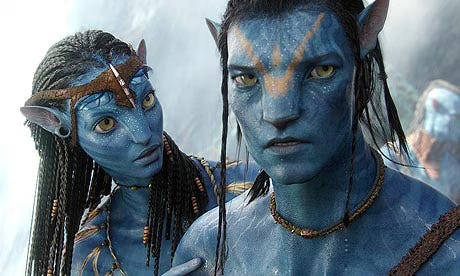
In the film, a human paraplegic ex-marine, Jake Sully (played by Sam Worthington), is sent to the Pandora, whose native inhabitants are a race of tall blue tribal biological beings called the Na’vi. Jake is able to control an “avatar”, an artificial (yet biologically grown) body of a Na’vi, which he inhabits and controls almost like a remote-controlled robot, from his “control pod” located in another part of the forest planet.
Thus, in this usage context and imaginary, we have a human controller, controlling a biological body (a robot or artificially grown body) from another location on the same planet. We can generalize this scenario and say that in this imaginary, the controller could be anywhere else in the physical world (leaving aside the speed of light communication latency issues, as theoretically we could be dealing with more advanced science and tech).
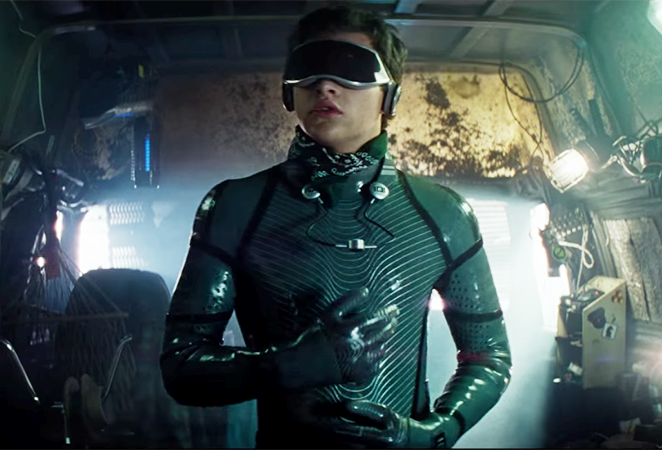
A second reason for the nomenclature has to do with the more common use of the term “avatar” today: characters in video games, which are controlled by players and with which the players identify. While the film Avatar deals with remote controlling a body from another location on the planet, this more common usage is about a character that represents someone or something else. In the case of video games that “someone else” is the player of the game, who exists outside of the “rendered world” of the game.
In the video game scenario, the player is not just outside the specific locale (or planet) in the game, he or she is located outside the physical universe that the avatar or game character lives in, which is a virtual world that is being rendered on some computing platform. In the original form of video game avatars, players can see their avatar being rendered on a computer screen (or mobile or tablet or TV screen). In multiplayer games, players can also see the avatars of other players that are in the same “virtual” location (i.e. near the same x, y, z, coordinates of the first avatar in a 3D world) but may be located somewhere else in the outside (i.e. our physical) world.
The control of the avatar by the player in video games is often achieved by using a video game controller, or a mouse, or a keyboard. Increasingly, science fiction has depicted more interactive and integrated control and rendering scenarios. In the case of films like Ready Player One (RPO), through a VR (virtual reality) headset and a set of controllers that fit the players body, such as a VR glove which allows for fine-grained control of the avatar’s hands and fingers to grasp objects and to interact with the virtual world. In RPO, there is also a full body suit that allows the player to experience physical effects from the virtual world, and an omni-directional treadmill that allows for movement and physical exertion.
In an even more futuristics scenario, in the film, The Matrix, the players (for example, Neo played by Keanu Reeves or Morpheus played by Laurence Fishburne) exist outside of the virtual world (called the “Matrix”) and are connected via a BCI, or Brain Computer Interface, and their identification is almost complete, forgetting that they are avatars in a virtual world.
The term avatar in the context of video games was put forth by Lucasfilm’s video game team, LucasArts, while they were building the multi-player game, Habitat and in the late 1980s. They borrowed from the Sanskrit term, avatara, which had to do when a divine being decided to incarnate into our world, onto Earth, in a human body. In the same way that an avatara was a kind of shrinking of a larger being into a smaller being, the creators of Habitat (Carlson & Morningtstar), felt that they were shrinking their persona into the telephone wires and borrowed the term and called their character their “avatar”.
In the context of the avatar hypothesis for UFOs, this shrinking down could mean coming from an external universe outside of this physical universe and might involve a shrinking of dimensions. This would be in the same way that in the novel Flatland, the residents of a 2D world need to interpret a 3D phenomena that they can’t quite understand - for example a sphere looks like a circle. There is also the implication that what we are seeing is a representation, a symbol, which appears real to us, but is meant to represent something else.
Simulation theory, which I use to describe this field more broadly, tells us that the term “The Simulation Hypothesis” was coined by Bostrom after he wrote his famous paper, Are You Living in a Computer Simulation? (Bostrom, 2003).
Bostrom was effectively arguing that we may in fact be code or AI running inside a simulation or computer program in his now famous “simulation argument”. In video game parlance, an AI character inside a video game is called an NPC, or non-playable character (the term itself derives from tabletop games like Dungeons and Dragons in the 1970s, but has gone into common usage in video games).
It is important to note that even NPCs have avatars (i.e. a visual character representing them). However, in my works, I draw a distinction between the NPC flavor of simulation theory and the RPG (or role playing game) flavor of simulation theory, where players exist outside of the game and control characters in the game (Virk, 2019, 2025). This is close to the flavor of simulation theory offered by Chalmers (2003, 2022) which Chalmers originally called “the Matrix hypothesis”, only to later adopt what became the commen nomenclature of The Simulation Hypothesis.n
The Avatar hypothesis in this paper is presented as an overlap between characteristics of entities (including craft) in UFO reports and the characteristics of avatars (or symbols representing outside entities) in a simulated/virtual reality or a video game.
Definition of the Avatar hypothesis
A slightly broad but formal definition of the Avatar hypothesis might be:
The avatar hypothesis for UAP proposes that the visible elements of the phenomena, particularly the craft, lights, and beings which have been reported, are actually representations of entities that are elsewhere. In the strict version, they do not originate from within our physical three-dimensional universe, but are projected into our universe, and are being controlled from outside of our physical reality.
Note that with this definition we are closer to the video game idea of an avatar, though we are not ruling out that they may also be remote-controlled from another location in our physical universe, in a less strict version. It should also be noted that the “elements” include what appear to be living beings as well as what appear to only be orbs of lights, or lights on a craft, or in fact, craft itself.
It should be noted that the avatar imaginary doesn’t necessarily require that we be in a computer simulation or a video game, but just that there is something else outside of our physical universe. For these purposes it may be worth defining the sub-versions of the avatar hypothesis more formally:
Avatar Hypothesis A0: That the craft and beings are being remote controlled from another part of our physical universe (the accompanying imaginary would be the film Avatar).
Avatar Hypothesis A1: That the craft and beings exist outside of our detectible or physical universe (the accompanying imaginary would be The Matrix).
The definition above and the rest of this paper will focus on Avatar Hypothesis A1, about UFOs or UAP elements being representatives or projections from outside of our reality.
Discussion and Comparison with Other Hypothesis
Before we go further, we should note that the avatar hypothesis for UAP is only partly distinct from other hypothesis, and it is useful to review some of these. As mentioned earlier, there is considerable overlap between the avatar hypothesis and some existing hypotheses, and in fact, between many of the existing theories themselves.
Many scholars of Ufology believe that we are not dealing with a single phenomenon, but rather multiple phenomena, which opens the door to multiple theories being true. In this case, UAP, which includes USOs (unidentified submerged objects) and traditional UFOs (unidentified flying objects), as well as lights and orbs, and finally, other related phenomena that have been classified as “high strangeness” around these readings. Though the government definition of UAP may or may not have intended to do so, we’ll include the abduction phenomena in this discussion as well.
Let’s review other theories, starting with the two mainstream hypothesis which the majority of today’s scientists use to interpret (and effectively dismiss) UFOs:
· Prosaic hypothesis — The on-going expectation of many scientists and skeptics can be classified as the “prosaic” hypothesis – which would mean that the phenomena is nothing unusual – just sightings of a prosaic nature, such as cloud formations, balloons, misidentifications of Venus or the moon or other natural phenomenon.
· Hidden Technology Hypothesis – This hypothesis is that the sightings which exhibit behavior that is outside of known performance characteristics of craft are in fact our own advanced technology, or that of our peers (i.e. Russia or China) and do not represent any kind of exotic technology but the ordinary progress of aerospace and nautical technology.
It’s important to note that these two “ordinary” hypotheses only attempt to explain the “nuts and bolts” part of the UFO phenomena, and not the “abduction” or “beings” part of the phenomenon. We could extend these to include the mainstream scientific explanation for this even more disputed aspect of UAP:
· Hallucination hypothesis –This hypothesis proffers that any communication or interaction with beings, including the “abduction” phenomena are not real. This could be because of hallucinations, sleep paralysis, or mental illness. For those that are willing to acknowledge a physical phenomena at play, a variation implies that it may be humans that are performing the abductions, but the subjects are having hallucinations that they are meeting beings which resemble the social imaginary of “aliens” (in this case smaller gray beings with large eyes).
While the goal of this paper is not to defend or dismiss these explanations, many researchers who are advocates of other theories have come to the conclusion that these explanations only cover some of the cases, and that the really interesting cases, both of craft and interactions with beings, are not adequately covered.
It should be noted that many scientists who have looked seriously into the phenomena, and have treated UFOs as potentially ontologically real, including for example John Mack at Harvard or Peter Sturrock at Stanford, have come up against a stigma within academia. For more on this stigma, including background literature and case studies of more recent examples of professors studying UFOs, please see my paper “UFOs in Academia: Stigma, Implicit Boundary Work and the Edges of Legitimate Science” (Virk, 2026).
Assuming that these researchers are correct and these ordinary hypothesis do not in fact account for all of, or even any of, the most interesting UFO cases, we must turn to the more non-ordinary hypothesis, including:
Extraterrestrial hypothesis - The most popular of these include the extraterrestrial hypothesis, which arose early on in the modern era of UFOs, and was typified by the term “flying saucer”. This has of course, been the most popular in the media as discussion. UFO researchers have noted that there have been unexplained objects and lights in the sky for much longer than the modern era. This hypothesis has also been used as a kind of straw man to disprove that the UFO phenomena is legitimate by scientists, given our current understanding of the distances between stars and the energy required to achieve interstellar speeds.
Ancient Astronaut Hypothesis – This variation of the extraterrestrial hypothesis implies that much of Biblical lore and other religious sightings of “angels” and “gods” were actually extraterrestrials. While this isn’t distinct from the extraterrestrial hypothesis, it is worth mentioning because this imaginary has taken hold thanks in part to, the extremely popular History Channel show, Ancient Aliens, and provides a re-interpretation of ancient data (i.e. Biblical stories of encounters with non-human intelligence).
While these both are quite popular in modern ufological discussions, the idea that the beings and craft do not come from other planets in other solar systems has also grown more popular since they were first proposed and there are various versions of these hypotheses including:
Ultraterrestrial hypothesis. In modern times, this hypothesis trace back to the work of John Keel, who defined the term “ultraterrestrials”, and Jacques Vallee, who noted that many of the interactions with these beings resembled the encounters in much European folklore. The essential idea here is that the beings (and craft) are coming from Earth and have always existed on Earth with us in some way. Hal Puthoff wrote a paper (2022) on the Ultraterrestrial hypothesis, categorizing it as “(e.g., ancient occult group, isolated pre-Diluvial high-tech society, stranded ETs/“gods”), i.e., sequestered terrestrial cultures … existing alongside us in distinct stealth.”
In this sense the ultraterrestrial is a broader categorization of several other hypotheses:
Breakaway human civilization– this hypothesis proposes that there is another civilization of humans, who have developed science and technology independently of mainstream science and thus have been in stealth using their technology. This could be an ancient human civilization or a more recent modern breakaway civilization.
Silurian hypothesis – this theory posits that there was at least one humanoid but distinctly non-human species that existed on planet Earth for a long time before humans. This species has survived but remained hidden, either below ground or in some other way. Once again pointing to the overlap of the imaginary with sci-fi, the term Silurian was borrowed from the science fiction series, Dr. Who, where there was a reptilian race that existing on Earth millions of years before humans called the Silurians. The Silurians went into hibernation inside the Earth, but were masters of the surface well before humans entered the scene.
Cryptoterrestrial - In this strand, or subset of ultraterrestrial hypothesis, which Case, Lomas & Masters (2024) define as “…the notion that UAP may reflect activities of intelligent beings concealed in stealth here on Earth (e.g., underground), and/or its near environs (e.g., the moon), and/or even “walking among us” (e.g., passing as humans).” The authors point out that Kastrup (2024) also argued that this idea was “the most reasonable” explanation for the far-flung UFO phenomena, and in earlier work, The cryptoterrestrials: a meditation on indigneous humanoids and the aliens among us (Tonnies, 2010).
Stranded aliens or gods. This strand overlaps with the ET hypothesis, but in the distant past and includes a technologically advanced ET civilization that has been here much longer than the modern era and thus have become natives of Earth. More on the “gods” idea below and its overlap with ancient alien hypothesis.
Folklore hypothesis. This strand, most closely associated with Vallee, suggests that the beings that have been reported in folklore are physical beings that have been here all along but that pop in and out of our reality. This is not only included with the ultraterrestrial idea, but overlaps with both the avatar and the interdimensional hypothesis.
You can see that categorizing these as sub-strands of the ultraterrestrial hypothesis is somewhat subjective, the theories clearly have overlap and don’t always lend themselves to clean breaks or separations of hypothesis.
Several more exotic hypothesis that are relevant are this discussion and should be compared and contrasted with the avatar hypothesis include:
Time-travel hypothesis. This hypothesis, most prominently proposed by evolutionary biologist Dr. Michael Masters, which he names the “extratempestrial hypothesis” is that what we are seeing are artifacts of human time travelers from our future. This hypothesis presupposes that we may someday be able to travel through time into the past (i.e. into our present or before). Masters in particular focuses on the beings, the most commonly reported of which are the “grays”, small gray hairless beings with very large eyes/pupiils, as being the end of an evolutionary trend of less physical labor, more mental labor, and if we were to move underground. This hypothesis also tries to explain some of the reported reproductive aspects of modern abduction reports. If we were to evolve in this way, it’s possible that the “future humans” might lack the ability to naturally reproduce, and this would why they seem particularly interested in human genes and in pregnant women, who often report that their pregnancy was prematurely brought to term during an abduction experience.
God & Angels hypothesis – note that this hypothesis is in some ways the flipside of the Ancient Aliens hypothesis, with which it agrees somewhat. Under this hypothesis, angels and demons and gods do exist outside of our world and can come into our physical universe. We are in the modern era misidentifying them as UFOs or alien or extraterrestrial craft, but the ancient interpretation of angels and demons is more apt. The western Christian religious interpretations often include hte idea that the beings which are being called “aliens” are actually “demons”, with some gnostics going so far as to identify them as the “archons” of gnostic lore, who work under a demiurge that is responsible for this reality. Both God & Aliens as well as the Ancient Aliens hypothesis agree that ancient sightings were similar to today’s UFO sightings, they are differeing about who had the correct interpretation of the phenomena - ancient mystics and scripture (Gods & Angels & Demons), or modern materialists (Extraterrestrials).
Interdimensional hypothesis. This hypothesis, which overlaps significantly with both the God & Angels and the Avatar hypothesis, and potentially the ultraterrestrial hypothesis as well, posits that the craft and beings come from “another dimension”. Whether this is another dimension to our physical universe, or something outside the physical world is left up to the interpretation of the reader. Angels and demons or jinn (the Islamic version of other beings that liave on Earth with us) might normally be in another dimension, as might other mythological beings that have been reported, so there is considerable overlap between this and other hypotheses.
Overlapping Characteristics of UFOs and Avatars
The reason the “avatar hypothesis”, along with other non-ET hypothesis, are being discussed more and more in modern ufology is because of characteristics of UFOs and abductions which seem to defy existing ideas of science, space travel, and even of physical reality.
Some of the characteristics that tend to encourage the idea of being projected from another reality can be looked at by dividing them up into two parts: the craft, and then the beings.
In the case of sightings, Hynek came up with a classification system which included night time lights, daytime discs, and those which had both a visual and a radar sighting. These were in addition to his 3 “Close Encounters” classifications (Hynek, 1972). Today, abductions have been informally classified as close encounters of the fourth kind (Bryan, 1996), and some have classified a fifth kind of close encounter, when participants psychically summon the UFO, often informally referred to as a CE5.
It is important to note that some sightings are just of light or orbs at night, and it is unclear if we are looking at a form of technological craft. In other instances, there is a clear interpretation of the object in the sky as metallic looking craft. Submerged object reports have often been caught on radar but mostly without visual descriptions, except in cases where the object has emerged from, or plunged into the ocean.
In the Avatar hypothesis, these “craft” are merely presentations or “avatars” of some underlying intelligence. Whatever intelligence is behind the phenomena would be presenting these objects to look a certain way – as technological craft.
Some of the interesting observations throughout history which support this idea include ancient description of objects as “chariots” and industrial revolution sightings of “airships” (before the Wright Brothers flights), foo fighters, and more recently, technological craft.
In the modern era, since Kenneth Arnold’s sighting in 1947, which led to the coining of the phrase “flying saucers”), many different shapes of UFOs ranging from egg shaped to cylindrical/cigars to discs and even more exotic shapes such as large red squares, cubes within spheres (and vice-versa) have been reported. In fact, the large variation of reports of objects/crafts just in the sky (not including orbs or USOs) has some uncomfortable implications. Accepting a physical hypothesis would mean that all of these are being manufactured by one very advanced civilizatation (unlikely, when we consider the number of variation of flying craft that we as a technological civilization have built), or we have to accept the perhaps even more outlandish idea (from some points of view) that there is not just one but dozens of technological extraterrestrial civilizations visiting Earth in the modern era (or dozens of hidden ultraterrestrial or cryptoterrestrial civilizations) which rely on very different technological models and possible even different “science”. A simpler explanation would be that these craft are avatars of some kind, they are being rendered into our reality from some place outside of physical reality.
If we look at the “observables” which came from Pentagon UFO programs, some of these include low observability, instant acceleration w/ no visible means of propulsion, antigravity, trans-medium. While the Pentagon list presupposes a material object or craft, other observables which weren’t in the Pentagon list but have been reported by UFO witnesses might include:
“instant materialization/dematerialization”,
“changing shape/appearance” and
“going through physical objects.”
There have been modern reports, for example, where the craft appears out of nowhere. This has led some to speculate about a science fiction sounding scenario – cloaking technology. However, it is possible that if we take the reports seriously, then these objects are manifesting at a particular set of coordinates without traveling in three dimensional space to those coordinates. This would be difficult or impossible in a purely physical world without extremely precise wormholes, not just in space, but within the Earth’s atmosphere. However, if we were in a virtual world, the standard way to travel to some distant location would be to portal there – to de-render from one set of x,y,z coordinates and to render at another set of x,y,z coordinates. Currently materializations and disappearances remain a mystery but a persistent aspect of ufo reports that suggests we may be looking at non-material objects which render into teh physical.
As for changing shape and moving through physical objects, Nolan related at least one case to me where two observers, in the same car, came up with materially different shapes. There have been instances and reports where one person saw the UFO and others that were nearby didn’t, begging the question whether we are dealing with a psychic phenomena of some kind or if the UFOs are “objectively” there. Vallee related to me at least one case where the UFOs reported came down at a certain angle and went through the large redwood trees, but the trees were unaffected. Similarly, in ocean-related cases, there seems to be no physical effects from submersion and acceleration under water.
All of these aspects suggest that the objects may be both visible and non-physical at different times. While this could imply holographic projection from our universe (i.e. as in a hoax), they could also mean that they are being projected into and rendering in our universe, becoming physical but with the ability to phase in and our of reality. Once they are fully in our reality, they would be as real as our cars and airplanes to us, but they have the ability to de-render or to change shape.
The Avatar hypothesis could account for the large variety of shapes (especially considering the basic geometric shapes that have been described), the way that UFOs move, the ways they are perceived by observers, and the ability to move through physical objects, and most importantly, the ability to shift shapes or exist in a superposition of shapes at the same time. In a virtual world, these behaviors would become perfectly explainable as renderings of objects that are defined by data which are rendered on individual’s rendering devices.
Overlapping Characteristics of UFO Beings and Avatars

Similarly, while the most popular accounts of interactions with beings have been with the “grays” there are many other shapes and species in the vast corpus of UFO reports. Moreover, during abduction experiences, these “beings” regularly move through walls, and seem to be able to stop and start time and alter the subject’s perception.
Even traditional accounts of non-human beings within folklore, such as the Fae in the Celtric traditions, and the jinn in middle easter traditions, have cases of these other beings, who are here on earth with us, phasing in and out of our reality. They could be better explained by being avatars of these beings projected into our reality rather than accounting for a vast panoply of other intelligent races and dimensions. Similarly, our perception of having seen angels, for example, or demons, might fit the avatar hypothesis that what we are seeing are symbols of these entities real existence, but projected into our physical reality.
In the reports of non-human contact in the case of “abductions”, but also in the cases of “contact” with non-human intelligence that is not directly related to abduction, we see a variety of descriptions.
The most popular beings by far are In the case of the most popular described beings of the grays, an image which appeared on the cover of Whitley Strieber’s bestselling account of abduction/contact experiences, Communion: A True Story (Strieber, 1987). Strieber’s terrifying account was picked up by the media and the cover was displayed in bookstores around the country. This prompted many other abductees to write letters to Strieber about their own experiences, now stored in the Archives of the Impossible at Rice University. The precipitator for many of these letters by experiencers was seeing the image on the cover of the original communion book, which led them to recall their own experiences.
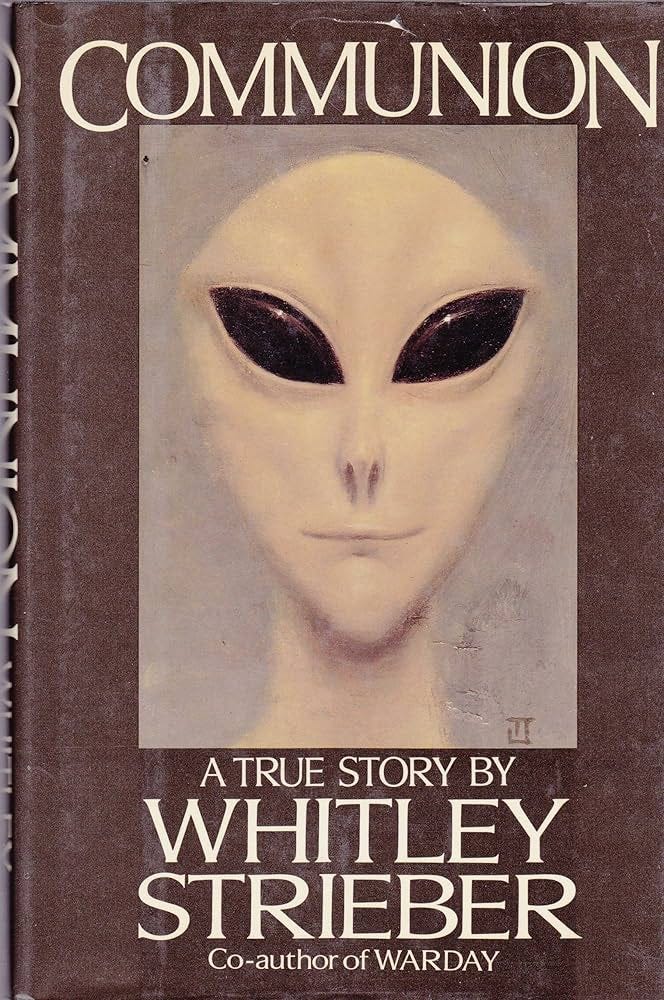
While this is the most common description, it is by no means unique. The various contact experiencers describe beings ranging from small grays (common alien), tall grays, tall whites, shadow beings, mantis beings, blue avians, and other insect-like descriptions. In the case of other contact experiences, we see descriptions of Andromedans, Pleaidians, Orions, Shadow beings, Mothmen, etc.
One outlier story that Strieber told me about and mentioned on his podcast particularly got me thinking about the possibility that what we perceive as “grey alien” beings may actually be projections or shapes or avatars which can shift shapes. This was the story of a young man whose girlfriend had gotten pregnant. In this report, she invited him to her apartment, and his thought was that they were going to get married and raise a family. Rather, she said that she needed to tell him that she was a gray alien, and according to the report, she transformed her appearance from human to that which we might think of as "gray alien”. She then changed back, but told him that she was going back to the world of her people, and that he would never see the woman or the baby again.
While such a story includes what some might call fanciful elements, if we take it seriously and ask, are there other contact experiences that have some of these elements? In the medieval Islamic literature, there are stories that sound almost identical involving human men marrying jinn women, and having children. The wife tells the husband at one point that she is going back to the world of the jinn, and taking the children with her, never to be seen again (El-Zein, 2017). These stories also have parallels within European folklore, as Vallee points out in this work, that humans should be careful not to be lured into the Fae world, and shouldn’t eat any food there.
As we expand our ideas of “contact”, the tapestry of beings begins to look even more complicated. In the case of DMT based contact experiences, multiple types of insectoid beings are often invoked, building on McKenna’s ideas about “machine elves”. The number of beings described in DMT-based contact experiences was so varied that it inspired authors and illustrators to write books like “The Illustrated Field Guide to DMT Entities: Machine Elves, Tricksters, Teachers, and Other Interdimensional Beings” (Brown & Huntley, 2025).
In many reported cases of contact, it seems that there may be some level of control over the appearance of these entities, who seem to exist outside of the ordinarily perceivable world. Their appearance may look almost indistinguishable from humans (human-like), similar to humans in shape but distinct (humanoid) or completely different from humans (insectoid or non-humanoid shapes). These beings also seem to have the ability to appear and disappear out of the physical world, and to appear in some cases, as near-humans. Is it possible that this faculty also covers ancient Native American ideas of skinwalkers, beings who are able to come into and outside of our reality and shapeshift? This would also correspond with angels and demons, who seem to have a similar ability to come into our reality when they want to be seen and be presented to us in humanoid form.
The avatar hypothesis suggests that these beings, when they project into our reality from “somewhere else” , can change their look as needed, and possibly customize it per individual. They can use contemporary human ideas or interpretations of what other beings might look like, once an idea of what an angel or an “alien” or a “machine elf” is born int he consciousness. This would be akin to simply changing the appearance of your avatar in a modern video game scenario.

Others have pointed out that the likeness of many (but not all!) beings to humans and humanoid shape seems unlikely in an extraterrestrial scenario, assuming independent evolution. Explanations could come in the form of some shared evolution or seeding or humans from the future.
However, another potential explanation that should be considered is the avatar hypothesis, that these beings are projected to look both familiar and unfamiliar to us. When they want to blend in, they wear “human avatars”, and when they want to present themselves as “others”, they present avatars that look like jinn, fae, grey aliens, mantis beings, etc. These are both similar enough that we could relate to them (as opposed to just being light or clouds or mist for example), but alien enough that we get the distinct message that they are not from “here”, are not human, and are in fact from “somewhere else”.
Conclusion
While the purpose of this paper hasn’t been to get into too much detail on individual sightings, many characteristics of traditional UFO sightings and reported abduction experiences leave traditional theories wanting, which is why many hypotheses have been proposed.
The purpose of the Avatar hypothesis is to combine some existing ideas (God & Angels, interdimensional, folklore) and to put forth a coherent hypothesis for how the phenomena could be appearing to us yet has its origins outside of our physical reality. Although I didn’t go into it here, the high strangeness that often accompanies UFO events is another arugment in favor of a non-physical explanation, or at least an origin that intersects with our physical world.
Further work can and should be done on mapping characteristics of individual sightings to elements of the avatar hypothesis, without prejudice towards a particular religion or folklore or interpretation. Similarly work could be done on a formal aspects of projection and rendering within physical and computer environments to explore these implications and compare those to individual abduction reports or craft sightings.
While no hypothesis (including the avatar hypothesis) covers all unexplained UFO sightings, this new flavor of theory brings forth new imaginaries which overlap with and extend current ideas about the origins of UAP/UFOs.
It is my contention in this paper, that we should be careful to draw conclusions based on past imaginaries and try to come up with theories which match the data, even if it is only in a subset of cases. For now, we can only speculate, as the phenomena themselves remain mysterious and essentially unsolved.
About Rizwan Virk
Dr. Rizwan Virk is a computer scientist, entrepreneur, venture capitalist and video game industry pioneer and bestselling author. He is a graduate of MIT and Stanford, founded Play Labs @ MIT, is currently at ASU’s College of Global Futures. He is the author of The Simulation Hypothesis, The Simulated Multiverse, and Wisdom of a Yogi. He recently completed his doctoral research at ASU’s Center for Science and the Imagination, and teaches at ASU’s Fulton Schools of Engineering, and is part of the Future of Being Human Initiative at ASU.
Follow him on Instagram @rizcambridge, on X @rizstanford, and at zenentrepreneur.com.